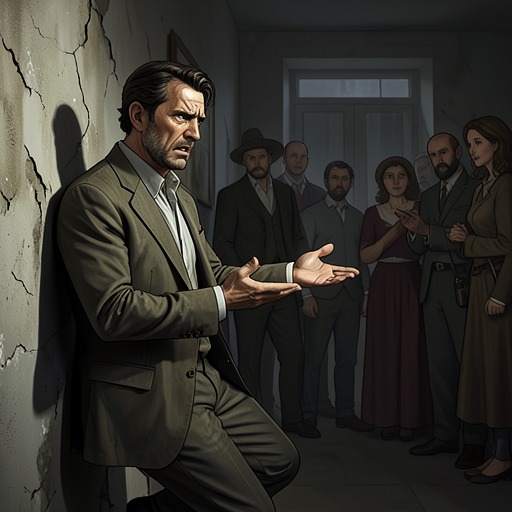
Rick Dalton and Jim Stacy’s on-set rivalry
Once Upon a Time in HollywoodRick Dalton and Jim Stacy’s on-set rivalry is both a performance strategy and a collision of professional identities. On the Lancer pilot, Wanamaker deliberately sets Stacy’s new series lead against Dalton, a familiar television cowboy recast as the villain Caleb DeCoteau. The tension gives the actors something to play, but it also presses on Rick’s fear that his career is fading and on Stacy’s concern that the production may be more interested in overturning Rick’s image than establishing his own star turn.
Casting and the stakes of the contest
The rivalry takes shape against Rick’s recent career shock. Marvin Schwarz has bluntly assessed Rick’s prospects, explaining that Italian filmmakers may want him as a substitute for Steve McQueen rather than as their first choice. As Rick listens, he feels tears beginning to build; the frankness lands with the force of a slap. His casting as Caleb therefore arrives at a vulnerable moment: he is not simply taking a guest role, but trying to understand what kind of actor the industry still believes him to be.
Wanamaker has chosen Rick to play the heavy opposite Stacy’s Johnny Lancer. The network selected the series leads, but the director chose Rick, anticipating what he calls possible gorilla magic between the two men. He wants Rick to use his experience to draw a stronger performance from Stacy, while remaining professional. In scenes together, Rick is to goad his younger co-star as if trying to persuade the network executives that he should be playing Johnny instead. The rivalry is thus built into the director’s working method: competition is not an accidental disturbance but a tool for producing charged performances.
That arrangement gives the contest an unusual balance. Stacy is the lead whose new series is being launched, while Rick brings the recognition of a seasoned television star. The role asks Rick to make that recognition work against him: audiences are meant to see an established Western hero occupying the villain’s place, then watch Stacy’s Johnny defeat him. For Stacy, winning against a performer associated with Jake Cahill would make Johnny’s victory feel larger than an ordinary triumph over a guest villain.
The mustache as a visible provocation
Facial hair becomes the rivalry’s most concrete point of contention. Wanamaker wants a large, drooping, Zapata-like mustache for Caleb, even though Rick dislikes fake beards and the spirit gum used to attach them. The director explains that he and Stacy had both wanted Johnny to wear a mustache, partly to give the series a more modern Western look. CBS rejected that idea and ruled that if anyone wore facial hair, it would have to be the heavy. Rick’s mustache is consequently not just costume design: it is the visible result of a decision that denied Stacy a look he wanted and assigned it to his on-screen opponent.
Wanamaker understands how the decision can sharpen the antagonism. He expects Stacy to be furious when he sees Rick wearing the mustache, and Rick himself asks whether it will bother him. The director confirms that it will, treating the network’s restriction as another subtextual layer between the actors. The costume department is also instructed to make Caleb look contemporary without making him anachronistic, bringing the sensibility of 1969 into the story’s 1889 setting. Rick’s fringed brown jacket and facial hair make him a conspicuous embodiment of the newer style that Stacy had hoped to claim for Johnny.
Stacy’s view from the set
On the first day of filming, Stacy sits outside the Hotel Lancaster on the Twentieth Century Fox back lot in Johnny’s red ruffled shirt and brown leather coat, sipping from a small green bottle of 7 Up. Seeing Rick’s mustache irritates him. His reaction has a history: at first he had been thrilled to learn that Rick Dalton, the star of Bounty Law and The Fourteen Fists of McCluskey, would play Caleb. Rick’s casting signaled that the studios and networks took the series seriously, and Stacy liked the idea of defeating a recognized television cowboy in the pilot.
That excitement is complicated by the production’s choices. Wanamaker had considered Joe Don Baker for Caleb, but chose the more established Rick because overturning a familiar Western persona seemed especially promising. Stacy knows the director likes the scale and novelty of that reversal. Now, with Rick wearing the mustache Stacy had wanted and apparently holding some of the scene’s best lines, he begins to suspect that the director’s greatest interest may be in subverting Rick’s image rather than introducing Johnny Lancer. Watching Rick and Wanamaker laugh together in their director’s chairs, as if they had made several films together already, makes Stacy wonder what understanding exists between them.
His annoyance does not erase his admiration for Rick. Stacy had enjoyed Rick’s earlier work and had welcomed the casting in principle; the irritation grows from the mismatch between that welcome and the unequal distribution of the pilot’s advantages. Rick has the iconic past, the conspicuous costume, and the director’s attention, while Stacy must establish a new lead character amid those competing attractions. The rivalry therefore carries both genuine professional insecurity and the playful, manufactured charge Wanamaker wants to bring into their scenes.
Rival images and a changing Western
The contest reflects a broader change in television and film Westerns. Wanamaker wants Lancer to avoid the familiar appearance of series such as Bonanza and The Big Valley, drawing instead on the grittier look associated with Italian Westerns. In the novel’s account of the industry, younger stars, more distinctive clothes, and morally dubious heroes are reshaping the genre. Johnny Lancer is designed as an unusually shadowed television lead, while Caleb is more than a routine villain: Rick recognizes that the character has some of the script’s strongest dialogue.
Rick’s changing view of his costume gives the rivalry another dimension. At first he worries that the makeup and disguise make him unrecognizable, as though viewers might not know it is him. Walking on the Western set, however, he sees Caleb reflected in a shop window. The boots, hat, and fringed jacket begin to feel less like an awkward disguise and more like a coherent character. Without his familiar pompadour, he can imagine himself as a modern actor rather than an aging cowboy associated with an earlier Hollywood. The role’s visual contrast with Johnny is also a chance to loosen the grip of the image that made Rick famous.
The actors’ competition is not a simple duplicate of the characters’ relationship. Johnny and Caleb are revealed to have been friends, adding a history of connection beneath the pilot’s conflict between hero and heavy. That complication suits a series trying to move beyond the clean divisions of older Western formulas. On set, the rivalry helps turn the casting contrast into dramatic energy; within the larger story, it exposes how a performer’s past roles can both grant him authority and constrain what others expect him to be. The evidence presents no final settlement between Rick and Stacy. Its decisive effect is the tension itself: a network restriction, a mustache, a director’s calculated goading, and two actors negotiating who will command the new Western’s attention.